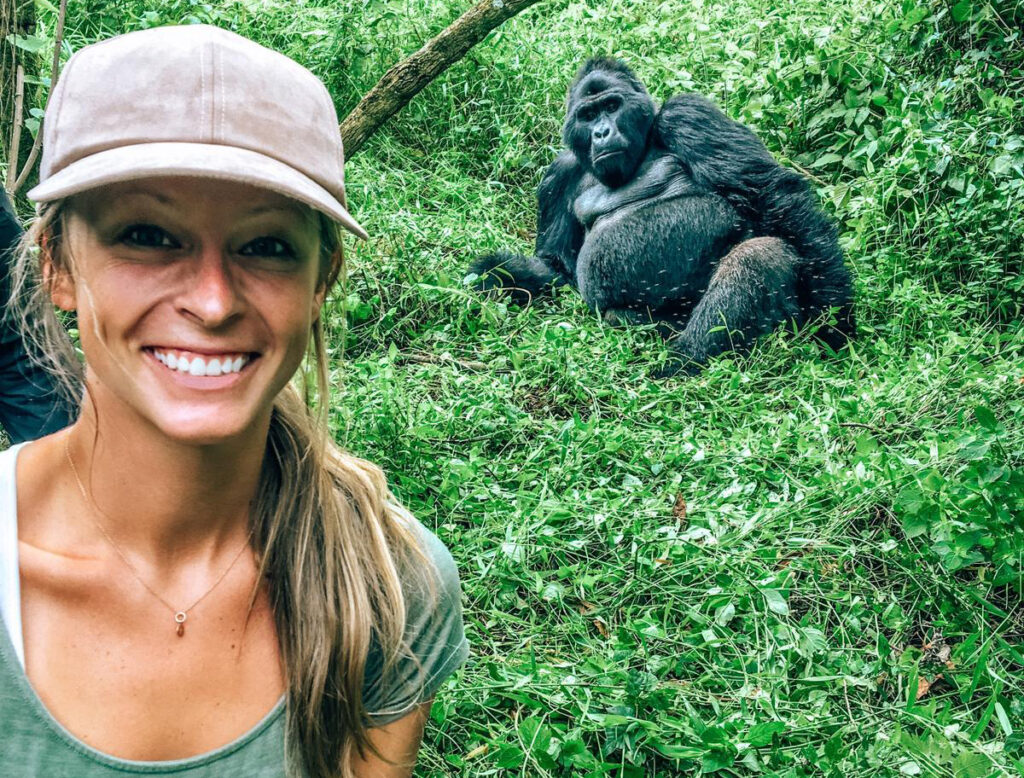
What is Gorilla Trekking

Over the last 27 years, the Buutu Safaris team has trekked mountain gorillas with hundreds of our guests. We have seen 13 gorilla families in Rwanda and Uganda. What remains constant is our failure to find the right words to describe a gorilla trekking experience. We will however give it another try here.

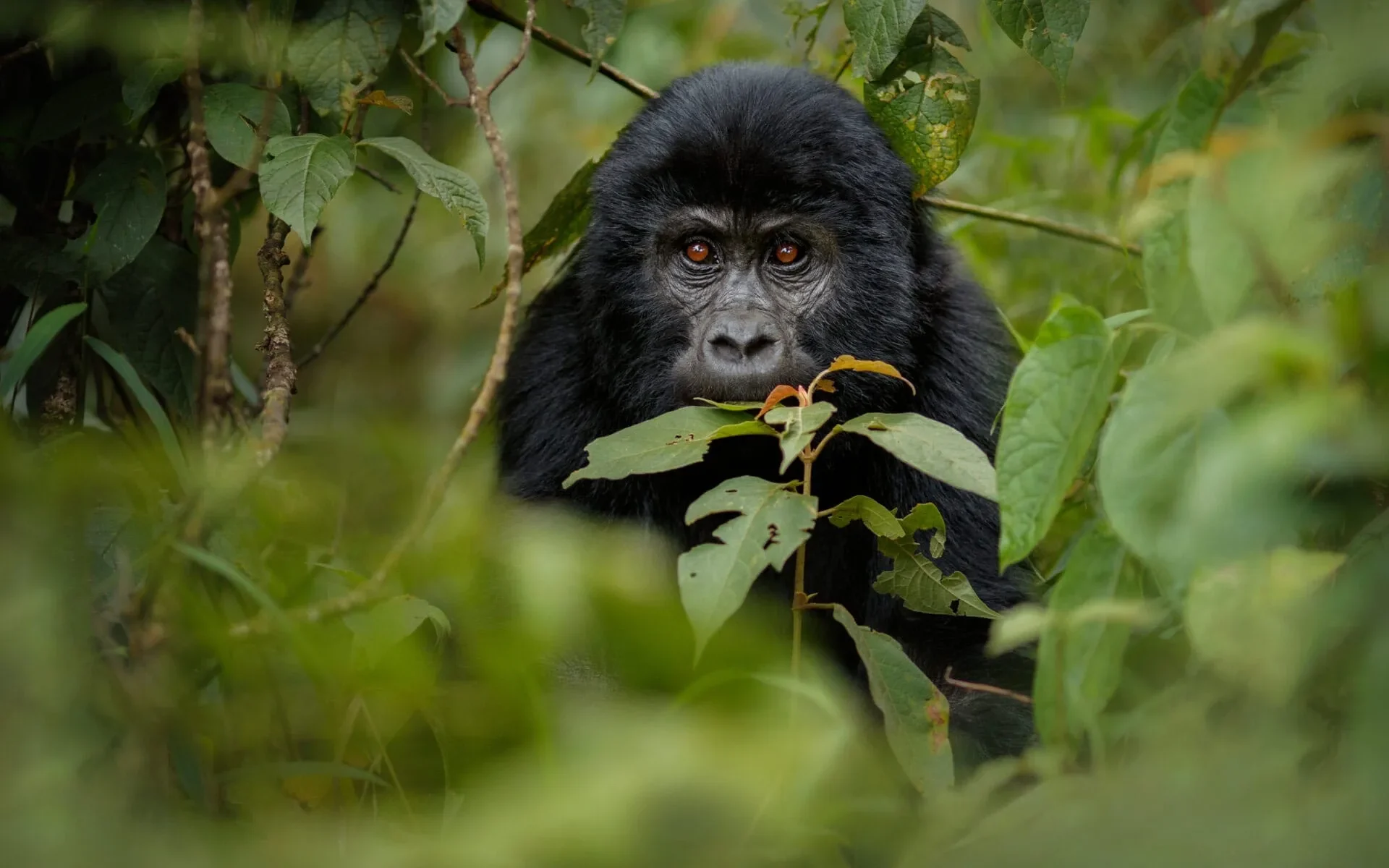
Mountain gorilla trekking is a once-in-a-lifetime experience. Gorilla trekking remains one of the most popular and unique wildlife activities in East Africa. It is a hiking activity that allows trekkers to come up close and personal with a family of mountain gorillas in their natural mountain tropical rainforest habitat.
The mountain gorilla (Gorilla beringei) is one of two subspecies of the eastern gorilla. It is listed as Endangered on the IUCN Red List, as the total population is estimated to comprise about 1,060 individuals as of 2021, following the COVID-19 lockdown birth boom.
Gorillas are part of the ‘great apes’ family of primates and are known for their beauty, high intelligence, social structures, and they display uncanny similarities to humans. Gorillas have been observed using tools like other great apes and can communicate using a variety of vocal sounds.
What is the Mountain Gorilla Trekking Experience Like?

Whether you choose to do it in Uganda, Rwanda, or DR. Congo, gorilla trekking in the western jungles of East Africa is an incredibly fun and unique experience that cannot be replicated anywhere else in the world. Gorilla trekking is, for us, the number one safari experience in Africa.


On the morning of the hike, trekkers head to the park office of their chosen national park for a briefing that starts at 800am. The rangers then spell out the “do’s” and “don’ts” of the trekking experience. After the briefing, the park office assigns a gorilla family to each group of trekkers, with each gorilla family being assigned up to 8 trekkers. Trekkers are given the chance to hire porters to help carry their gear and to support trekkers up and down the steep slopes during the trek. We always encourage trekkers to hire porters not just for support during the hike, but also to support livelihoods in the communities around the national park by providing much-needed income to marginalized youths. Trekkers are also provided with hiking sticks. Thereafter, it is time to start the trek deep into the mountains in search of the gorilla family.


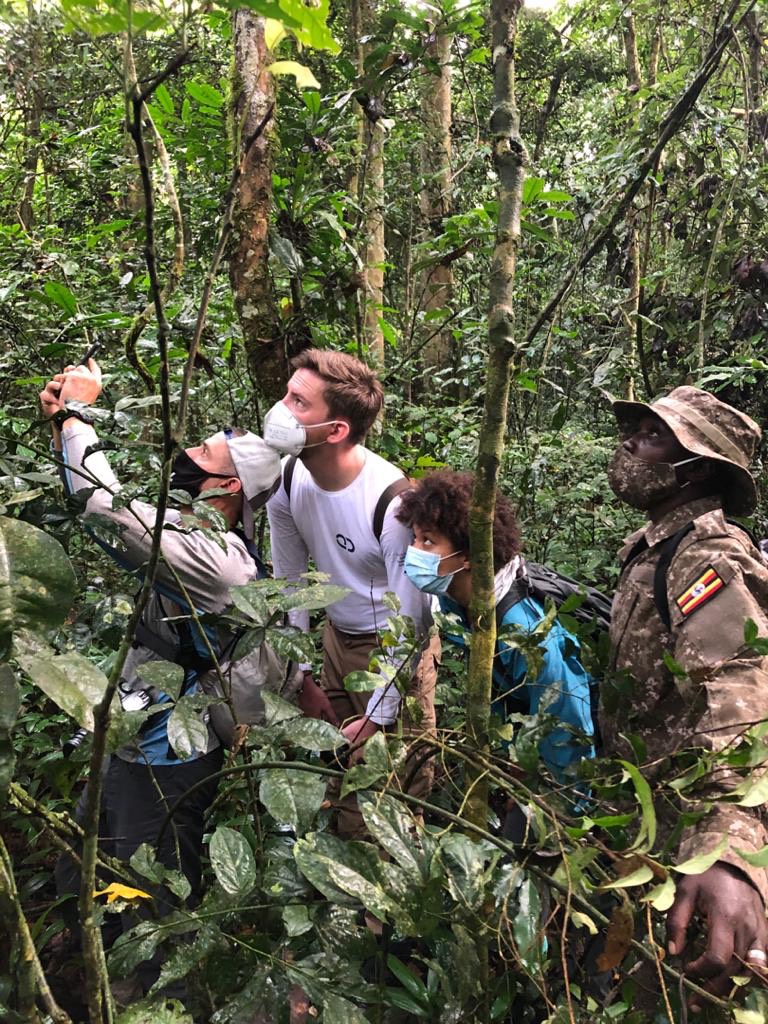
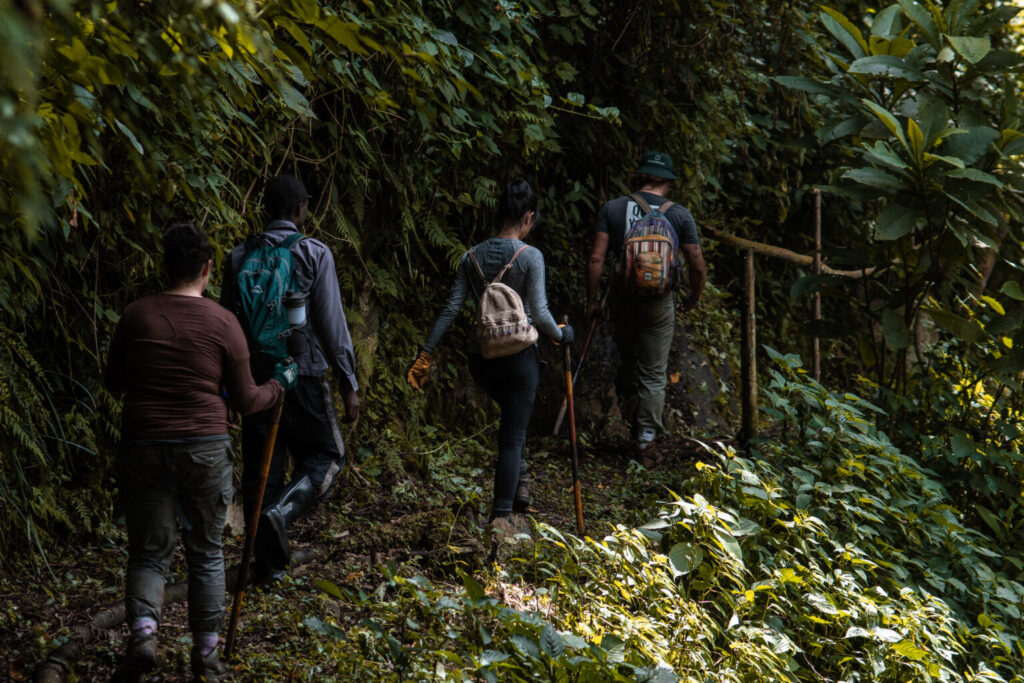
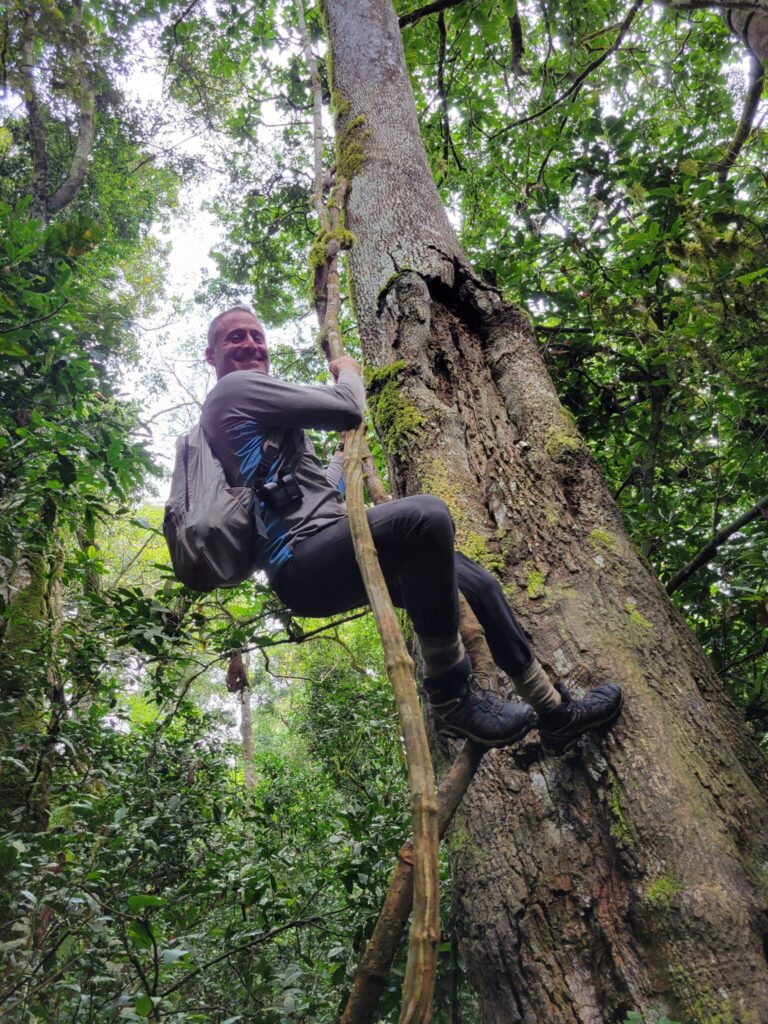
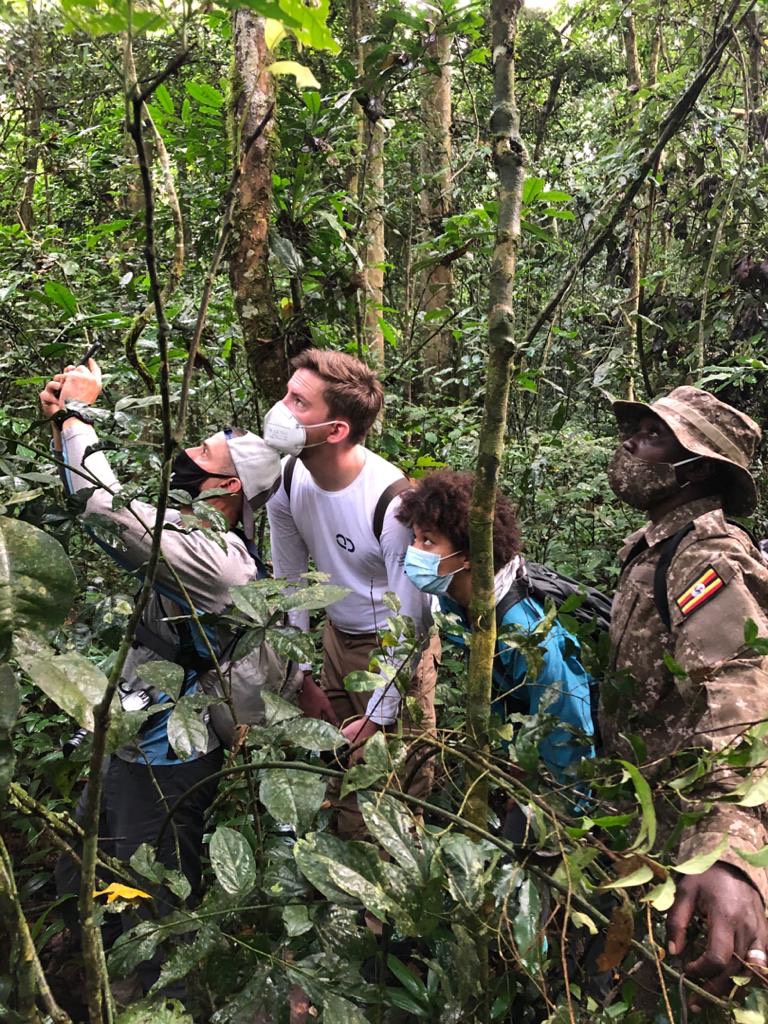
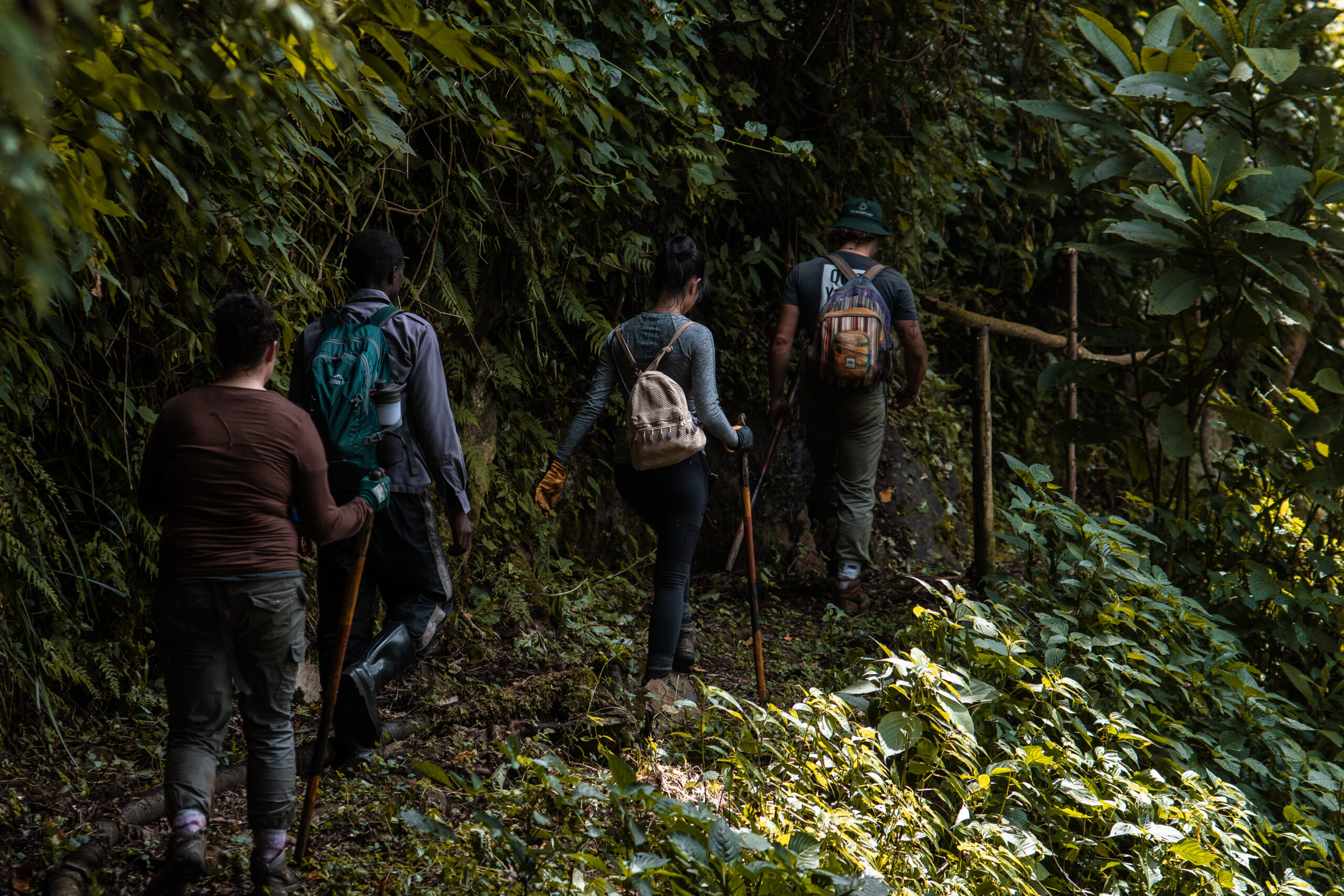
The armed rangers lead the group into the forest with one ranger at the front of the column and the second ranger at the back. The rangers guide the trekkers up and down the narrow trails into the magnificent high-altitude tropical forest. The morning hike is a memorable experience in and of itself. The hike normally starts as the morning mist rises from the forest floor. And on a sunny day, the early morning sun rays pierce through the forest canopy and the rising mist, making for a picturesque scene like no other. This is all made better with the soundtrack of forest sounds and countless birdsong that filter through the forest.


As trekkers make their way through the dense forest, the rangers will show them the ancient forest trees and the unique vegetation in this montane forest. Trekkers are also encouraged to look out for the other wildlife treasures that the region has on offer. There are forest elephants in some of the parts of the park, but it is extremely rare to see one. However, the footprints of these giants are ubiquitous throughout some parts, providing a good reminder of how capable these elephant giants are in most unlikely steep terrain. The region has several other amazing mammals such as antelopes, chimpanzees, golden monkeys, red-tailed monkeys, black-and-white colobus monkeys, among others, that share the mountain forest habitat with the gorillas. The region is also one of the richest birding areas in the world, with over 350 species in Bwindi National Park and 295 species in Volcanoes National Park. Watch out for endemic bird species in Bwindi and Mgahinga such as the Handsome Francolin, the Rwenzori Turaco and African Green Broadbill. In Volcanoes National Park, look out for the Laden’s Bush-Shrike together with 16 more endemic bird species. Trekkers can find over 200 species of butterflies in the region.
Gorilla trekking typically takes between 2- 7 hours and can be a challenging task for the inexperienced trekker. Trekkers must be in good physical condition before embarking on the trails. The terrain is composed of steep slopes and dense forest at high altitudes. Trekkers will hike at elevations of 1,500–4,000 meters (the same height a skydiver jumps out of a plane!).

Expect to wade through shallow streams and rivers during your hike. The hike gets a lot more challenging if there is heavy rain on the day of the hike, and trekkers are advised to always go prepared for rain. The forest floor can get muddy and slippery, so good hiking boots are a must. Our longest hike was in the southern section where we spent 7 hours trekking the Mucungunzi family of gorillas in the Rushaga sector of Bwindi NP. Some gorilla families can be found closer to the starting point, but there is never a guarantee that the trek will be a short trek. Our shortest hike was a 20-minute hike in search of the Rushegura family in Buhoma in 2013, but there is never a guarantee the trek will be short.

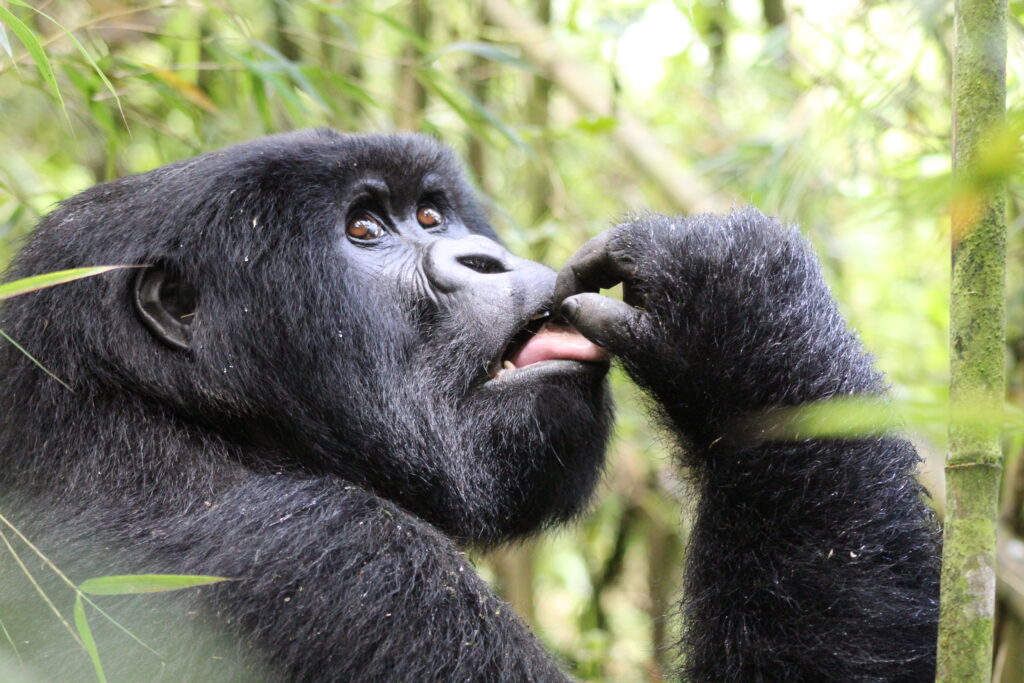
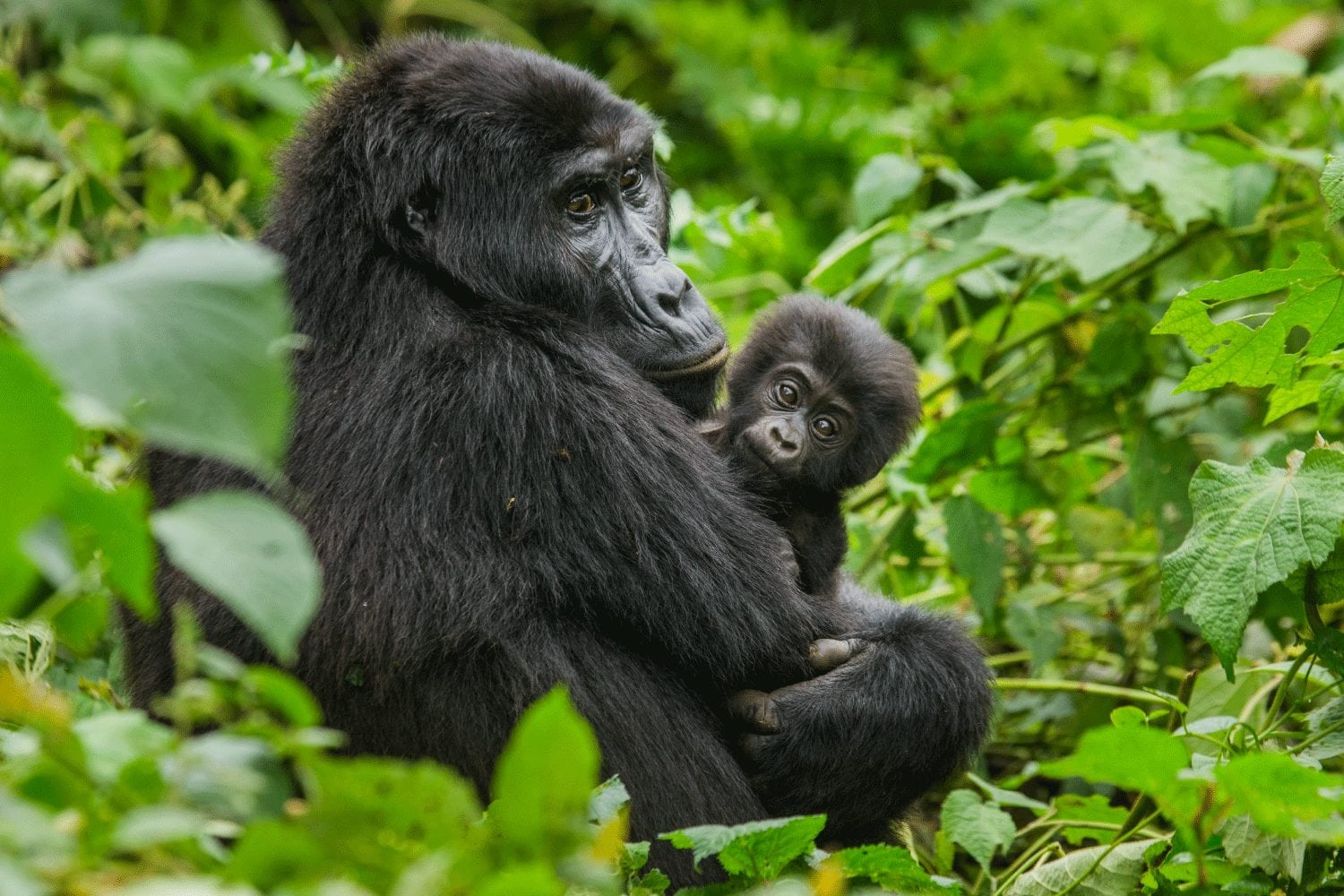
Despite the challenges, the experience of meeting the gorilla family after a long hike is well worth the tiring hike. Once found, the sight of the magnificent mountain gorillas is worth every ounce of energy expended. The gorillas are normally found feeding or resting or, on the odd occasion, moving. The gorilla family is typically composed of about a dozen members, though there are families with over two dozen members. Each family is headed by a ‘silverback’ gorilla who is the alpha male and head of the family and is tasked with protecting the family from predators, other gorillas, and any other threats. Other members include several female gorillas, infants, and ‘blackbacks’ (young silverbacks). Some families will have 2 silverbacks, as gorillas are known to look after the older members.


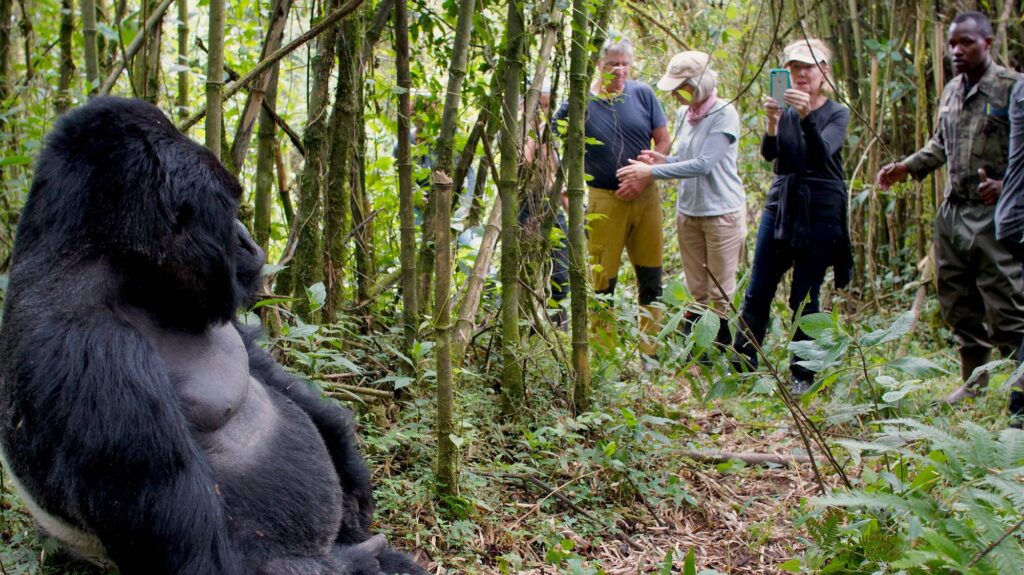
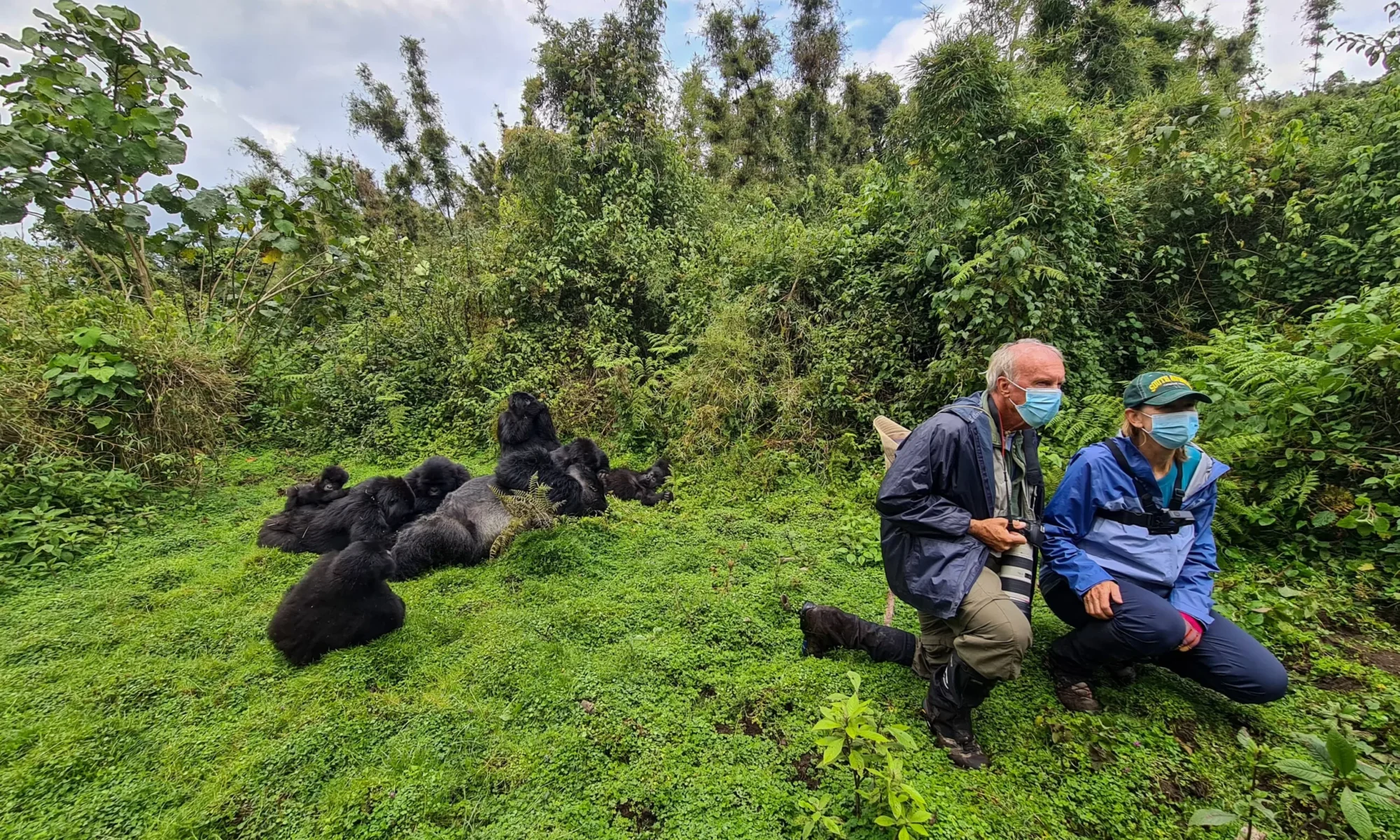
Once in the presence of the gorillas, trekkers will quietly observe these magnificent primates as they eat, groom each other and play in the forest. Trekkers are allowed to spend a maximum of one hour observing the gorilla family. This is the time for taking photos, though flash photography is strictly forbidden, which makes gorilla photography one of the most challenging wildlife photography. Trekkers are always told to keep a distance of at least 10 meters from the gorillas. This is because gorillas share 98% of their DNA with humans, so human presence presents a deadly threat of communicable diseases to the gorillas. Also, the silverback gorilla is very protective and won’t hesitate to physically attack any perceived threats to its family.


There is no guarantee that the gorillas will stay in one place once you meet them. Sometimes the gorilla family will keep moving deeper into the forest to forage or as they look after the young babies. Trekkers might end up seeing the gorillas on the move.
Our experience trekking mountain gorillas over the last 27 years has taught us that it is preferable to trek large families with juvenile and infant gorillas. From our trekking encounters, trekking families with more gorillas and with more juvenile and infant gorillas is always preferable. This means that this family is not constantly on the move and takes long breaks in the forest. Therefore, trekkers will have more time to watch the gorillas. The younger gorillas are also more playful and tend to put on a show upon the arrival of gorilla trekkers. Juvenile gorillas have been known to somersault, play-fight with each other, and even pull at guests in curiosity. Watching the juvenile and infant gorillas as they play about in the forest is a memorable experience.

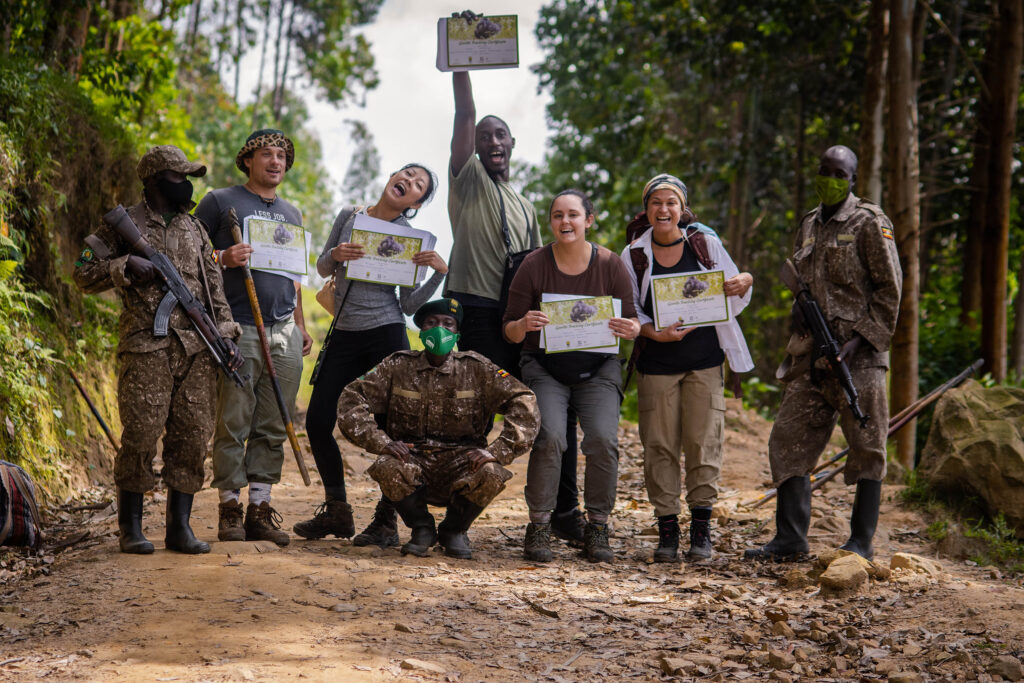
Once the allotted time with the gorillas has elapsed, gorilla trekkers follow the original trail back to the national park office for a debriefing session. Trekkers then receive a gorilla trekking certificate indicating the trekker’s name, gorilla family tracked, and the section of the park hiked.

Where Can I Go Gorilla trekking?

Mountain gorilla trekking can only be done in one place in the world in a region encompassing three countries: Uganda, Rwanda, and the Democratic Republic of Congo, where these primates exist in their natural habitat of dense high altitude tropical forests.There are two major gorilla populations available for trekking. One population lives in Bwindi Impenetrable Forest National Park (a UNESCO World Heritage site) located in southwestern Uganda. The other gorilla population lives in the Virunga Mountain range in three adjacent national parks: Uganda’s Mgahinga Gorilla National Park, Rwanda’s Volcanoes National Park, and Virunga National Park in the Democratic Republic of Congo.
These national parks are the last surviving natural habitat for mountain gorillas. Mountain gorillas do not survive in captivity and need their expansive forests for survival. They were on the brink of extinction in early 1990s but the commendable efforts of governments and conservation bodies has seen their numbers increase from 400 to 1,060. This has been done through gorilla trekking tourism, and the conservation of mountain gorillas remains one of the successful efforts of conservation in Africa.


Trekkers have the opportunity to go gorilla trekking in all three countries. However, Uganda and Rwanda remain the most popular destinations for gorilla trekking primarily due to ease of access, political stability and the fact that the Democratic Republic of Congo has persistent security challenges.
How Much Does Gorilla Trekking Permit Cost?

Before you travel to any national park to see the gorillas, you must buy a ‘gorilla permit’. The permit grants you access to the national park for one day. In each country the number of people allowed to trek gorillas is limited. For instance, in Uganda, each of the four sectors of Bwindi national park are allowed only 40 people per day. This is done to ensure that the natural forest habitat of the mountain gorillas is preserved in pristine condition. It also ensures that the gorillas are not stressed from constant human interactions throughout the day.
The cost per person of trekking gorillas varies by country:

Uganda: $700

Grants you access to any one of the four sectors of Bwindi Impenetrable National Forest: Rushaga, Nkuringo, Buhoma, and Ruhija, OR Mgahinga Gorilla National Park.
Each permit you buy is valid for only one sector of the park and is not transferable to other sectors or parks in the region. For example, the permit you buy to trek in the Rushaga will not be accepted in Buhoma.

Rwanda: $1500
Grants you access to the only gorilla national park in Rwanda: Volcanoes National Park.
This is by far the most expensive option in the region.

The Democratic Republic of Congo: $600
Grants you access to the Virunga National Park. Congo offers a cheaper trekking permit alternative to Rwanda and Uganda.
The permit fee does not include food, accommodation, and transport costs. Buutu Safaris offers trekkers several Uganda gorilla trekking options that are inclusive of the permits, accommodation, and transportation, to save trekkers the hassle making their own arrangements. Besides Uganda gorilla tours, there are also options for gorilla tours to Rwanda.

Gorilla trekking is one of the tourism platforms that has led to the conservation of gorillas by creating employment for Ugandans, Rwandans, and Congolese. The income-generating ability of this creative approach is at the center of economic development in the gorilla highlands and is the key factor behind the success of gorilla conservation.

What Equipment Do You Need For Gorilla Trekking?

  • Copy of valid Passport or National ID
  • Face mask (N95/Surgical)
  • Personal sanitizer
  • Hiking boots
  • Raincoat
  • expect rain any day and month of the year.
  • Walking trousers & long sleeved to ease movement through scratchy bushes
  • Sunglasses
  • Sunscreen
  • Insect repellant
  • Pair strong gloves to handle prickly bushes and trees.
  • A good camera (strictly no flash photography in the park)
  • Waterproof bag
  • Light shoulder bag to carry Water bottle, packed lunch, rain gear and other trekking essentials.
  • Extra cash in local currency
  • A pair of keen eyes!

How much does a gorilla safari cost?

Gorilla trekking is a once in a lifetime activity and remains on top of many bucket lists. Gorilla trekking permits in Uganda cost $700 whereas in Rwanda, a permit goes for $1,500. Yes, there are also gorilla permits for $400 in DR Congo. But the reason we mention them last is because gorilla trekking in DR Congo could cost you an arm and a leg. Literally! The eastern part of DR Congo remains unpredictable with continued insecurity in the area. Gorilla permits are expensive compared to other safaris because the forest can only accommodate a small number of gorilla trekkers given the sensitive ecological system of the gorilla forest habitats in Uganda, Rwanda and Congo. The opportunity to go into the wilderness can only be reserved for a small number of people in a day lest the forest face irreversible destruction. Gorilla trekking has been carried out in good balance for the past decades and the conservation of gorillas is one of the most successful conservation efforts of the last 3 decades. The limited supply of gorilla permits explains the high prices of gorilla trekking safaris.

How much does the gorilla safari cost? It depends on the following factors:

1. Gorilla Permits
We have already mentioned the cost of a gorilla permit in different countries. If one chooses to go trekking in Rwanda it will be more expensive because the permits cost twice as much in Rwanda for no apparent reason.

2. Number of Days spent on Safari

Safari is a Swahili word that means a long journey. Gorilla safari cost will thus depend on how many days you choose for safari. If one chooses a safari with more days so as to see and experience more of Uganda or Rwanda, then the gorilla safari cost generally turns out to be more expensive.

3. Transportation
Guests can either drive to the gorilla forests or fly to airstrips closer to the airstrips. If one chooses to travel by road it is cheaper though it is quite a long drive to southwestern Uganda. However, if one chooses to fly to the airstrips near the gorilla highlands then one should be prepared to pay more.
4. Accommodation Lodges/hotels
Luxury safaris cost more because guests are accommodated in expensive hotels. Lodges in Rwanda like One and Only cost $1200 – $5000 per night. Clouds Lodges in Uganda costs over $1200 a night. There are several lodge options in Uganda that cost $100 – $400 a night.
5. Safari Agents: Abroad vs Local Uganda or Rwanda Agents
Safari has always been offered by agents like Newton, Tarlton and Co Ltd since 1900. Safari was a preserve of a few wealthy elite. A lot has changed since then but some things persist top of which are the safari agents in New York, London Berlin, Los Angeles, Sydney, Amsterdam etc will charge a stiff premium but then employ locals in Uganda or Rwanda to do the safaris. The same safari will generally cost twice as much yet half of the safari cost will not reach safari countries where safari money is crucial in development and in reducing poverty. There are now many reputable agents in both Rwanda and Uganda. Gorilla safari operations by local agents in both countries are a great example of how local agent safari has played a crucial role in reducing poverty and advancing conservation. Always check the Association of Uganda Tour Operators list for top operators and the Rwanda
Buutu Safaris has a gorilla safari for everyone. Check out our various safari options from 3, 4,5,6 Day gorilla safaris to 21 Day Uganda Gorilla excursions.

Uganda or Rwanda for gorilla trekking?

Uganda and Rwanda are two of three countries (DR Congo is the third) in the world where mountain gorilla trekking is possible. For decades, the Buutu Safaris team has gone on gorilla tours in both Rwanda and Uganda with hundreds of trekkers from all over the world. A common refrain among prospective trekkers is “which is better for gorilla trekking –Uganda or Rwanda?” To comprehensively grasp this, one needs to analyse the border history of Uganda and Rwanda. Like many African borders, the Uganda – Rwanda border is a recent colonial imposition. Colonialists drew arbitrary borders with little regard to history, culture and ecology. This left a legacy of confusion along with challenges in conservation. But Uganda and Rwanda are more similar than they are different. Rwandans and western Ugandans speak a similar language and have similar culture. The gorillas are similar and live in the same highland landscapes. Both countries offer amazing gorilla trekking experiences and we’ll take a closer look at the difference and similarities of the trekking experience in both countries.

The Case for Rwanda

Rwanda is a landlocked country in the western sector of the Great Rift Valley, a few degrees south of the equator. Rwanda is bordered by Uganda, Tanzania, Burundi and the Democratic Republic of Congo. It is one of Africa’s smallest countries, covering an area of just 26,338 square km of land (about the size of Albania). Rwanda is known for its mountainous landscape and is nicknamed ‘land of a thousand hills’ with cities scattered across very high elevations. Rwanda has a rich biodiversity which includes rainforests, hundreds of species of birds, antelopes, several primate species including golden monkeys, chimpanzees and the highly sought after mountain gorilla.
Rwanda gorilla trekking tours are done in the Volcanoes National Park which is home to about 340 mountain gorillas clustered in 12 families. These gorilla numbers are comparable to those in Bwindi Impenetrable Forest National Park in neighboring Uganda. VPN is known for its unmatched ambiance, hospitality and amenities. Trekkers reporting to the park headquarters at Kinigi are given a complimentary cup of coffee and there is free Wifi access on the premises.

The Rwanda Development Board issues a total of 96 gorilla permits daily as each of the 12 gorilla families is limited to a maximum of eight trekkers per day.
In spite of the high altitude terrain with numerous hills and mountains, the park is easily accessible by road and Rwanda boosts some of the very best road infrastructure in the region. The park is easily accessible from the airport, which is a 2-hour drive (160km) through the picturesque region of the Gahinga, Karisimbi, Muhabura, Bisoke, and Sabinyo volcanoes.
Before the tour, a $1,500 gorilla trekking permit is required of all trekkers, in addition to a $50 PCR test for COVID-19 which is done to ensure that the gorillas don’t get infected.(as of Dec 2022) Trekkers have to bear in mind that gorillas share 98% of their DNA with humans and can easily contract human diseases.
Volcanoes National Park and Mgahinga National park are one and the same except for an artificial border created in colonial times. The park has three volcanoes with Uganda’s Mgahinga Gorilla National Park, the terrain and trekking experience are somewhat similar, though in Rwanda the experience comes at a higher price than Uganda.

Other things to do around Volcanoes NP:

  • Game drives in Akagera National park
  • Golden monkey tracking
  • Kigali City and genocide memorial Historical Tour
  • Hiking Karisimbi Volcano, Gahinga, Muhavura or bisoke, which typically takes 2 days.

A Case for Uganda

Uganda is the most unique of the two countries, offering contrasting landscapes featuring swathes of savanna grassland and dense tropical rainforests. Measuring 93,000 square km, Uganda is a landlocked country bordered in the north by South Sudan, DRCongo in the west, Kenya in the east, Tanzania in the south and Rwanda in the southwest. Dubbed the “Pearl of Africa”, Uganda is one of the most ecologically diverse places in the world featuring numerous lakes, rivers, vast swamps, snow capped mountains, tropical rainforests and savanna grassland. Visitors are blown away by the variety of flora and fauna and dramatic changes in landscape. Unlike Rwanda which has no savanna grassland, Uganda has both mountain rainforests and savanna grassland within 3 hours of each other. As such, trekkers have the opportunity to see gorillas and go for game drives in national parks that are close to Bwindi Impenetrable Forest National Park. Game drives in Ishasha tree climbing sector of Queen Elizabeth National Park which is about 3 hours away offer exciting add on options for gorilla trekkers.

In Uganda, the mountain gorillas tour is available for trekking in two national parks. One gorilla population lives in Bwindi Impenetrable Forest National Park (a UNESCO World Heritage site) located in southwestern Uganda. The other gorilla population lives in the Virunga Mountain range in Mgahinga Gorilla National Park located on Uganda’s border with Rwanda. Bwindi Forest NP is by far the most popular park of the two and is divided into four sectors: Ruhija(average difficulty) Rushaga (has a mix of hard and easy), Buhoma (medium, gorilla close) and Nkuringo (most steep).
Uganda charges $700 for gorilla permits –a bargain compared to the $1500 tab in Rwanda. Gorilla permits are pre booked through the Uganda Wildlife Authority or a travel agent before traveling to Bwindi/Mgahinga. Unlike Rwanda, there is no need for a PCR test for COVID. Nonetheless trekkers must wear a face mask to safeguard the mountain gorillas from COVID and communicable diseases they could contract from contact with humans.

The permit is also valid for only one sector.
Bwindi impenetrable national forest park is home to about half of the world’s mountain gorilla population. This ancient forest (and Africa’s oldest rainforest) is also home to antelopes, chimpanzees, golden monkeys, red tail monkeys, black and white colobus monkeys, forest elephants, among others. Bwindi boasts over 350 species of birds (including several endemic species) and more than 200 species of butterflies.
From our experience, each sector offers its own unique trekking experience:
Buhoma: the gorillas here are the most accessible. There is an incredible nature walk to three waterfalls.
Nkuringo: has amazing views of the virunga volcanoes. Offers the most challenging treks due to its very steep trails. There is the opportunity for a forest walk in the Buniga forest.
Ruhija: nature walks to the swamp from which bwindi gets its name.
Rushaga: has the largest number of habituated gorillas. Might see the forest elephants if you are lucky.

Proximity to Add on Big Game Experiences

Queen Elizabeth National Park is only about 3 hours away from Bwindi, so trekkers looking for a savannah safari experience have the opportunity to explore the vast savanna grassland teeming with wildlife for a change of scenery. This is the beauty of Uganda –these two national parks are just a few hours apart but offer vastly different experiences.
Mgahinga National park is Uganda’s smallest national park, but in our experience, one of the most impressive. The park has three of the eight volcanoes that make up the Virunga volcanoes: Muhavura(4,127m) which has a lake at the top, Mount Gahinga (3,474m) –swamp-filled crater, and Sabinyo (3,669m) which is on the corner where D.R. Congo, Uganda and Rwanda meet. For years, there has been only one habituated gorilla group in the park. However, this group has in the past crossed borders into Rwanda. In case this happens during your tour, you will automatically get a new permit for Bwindi.

Other Activities besides gorilla trekking:

  •  Game Drives in Queen Elizabeth, Murchison Falls or Kidepo National parks
  • Trekking chimpanzees in Kibale, Queen Elizabeth or Murchison Falls NPs
  • Trekking golden monkeys in Mgahinga National park
  • Hiking into Sabinyo Gorge and to the other volcanoes
  • Canoe rides on the scenic lake Bunyonyi and lake Mutanda

Trekking the Kahungye Gorilla Family in Bwindi

Gorilla trekking in Uganda finally resumed in an effort to reopen tourism. This was after the complete shutdown of tourism in Uganda for months owing to the Covid 19 pandemic. We were therefore lucky to have a group of 12 guests going gorilla tracking as one of the first groups to go tracking in a while. The residents of Rushaga village in Bwindi were visibly happy to see tourists return as their livelihoods rely mainly on tourism revenue. Upon arrival at Rushaga gate of Bwindi, it was clear new covid 19 prevention procedures had been well thought through and were being strictly implemented. We had to step and dip our shoes into 2 different basins each with a blanket soaked with disinfectant. This was to ensure trackers didn’t carry germs from their shoes into Bwindi.

In addition, all trackers were required to wear a mask and sanitize upon entry. This was reassuring because the gorilla population is still quite low so a virus like covid could easily wipe out this endangered species. We were assigned to the Kahungye family. Kahungye means Hills in Rushaga area.This is where the first gorilla family was seen hence calling it Kahungye. We headed out into the forest in a group of 8 guests , two ranger trackers and 6 porters. This time round we started on a marked trail so the beginning was relatively easy. February is a dry season so it made it even easier to hike with no risk of slipping in muddy ground. We went through a secondary part of the forest which has rejuvenated over the past 3 decades so the undergrowth was noticeably less dense but still impressive. Up and down, we made our way through the endless ridges that make up this imposing habitat.

Within a few minutes breathing was a bit difficult with the masks on and guests commented he had understood why Bwindi was named impenetrable.
We finally arrived at the gorilla’s location. The location had been located by the lead trackers who always set out much earlier than we tourist trackers. Once again we had to sanitize our hands as excitement of being in the presence of gorillas grew. Our first glimpse was of the silverback but only his rear side of the neck and head. A hint of silver hair on the lower back neck was visible and occasionally he looked up at us. The rangers told us that they could tell from the sheer size of the visible upper body and from his quiet confident demeanor that he was the patriarch silverback. Mr Silverback’s big upper body was visible but the rest of the body was covered in dense foliage. In the excitement of the moment, we all tried to get a better view of Mr Silverback as the rangers endeavoured to show each person in the group. He occasionally turned back to glance at us but continued stuffing his mouth with leaves confident in the fact we were no threat to him despite us occupying strategically higher ground.

The rest of the gorillas were in close proximity to the silverback as is the case with gorillas families. However, the dense foliage obscured the rest of the gorilla family. It’s only the sound of breaking vines and movement alerted us to the presence of various gorillas in proximity. But as if on cue, the Silverback started moving away downwards further into the thick foliage causing the rest of the gorillas to follow him. We took heed and followed the family into dense vegetation. We carefully made our way through thick undergrowth and overhead vines at times holding each other’s hands to avoid falling. The rangers had told us the family was composed of 17 members. Eventually, we could see the mothers, the newborn, juvenile gorillas of between 2 – 6 years and the silverback watching over every gorilla and trackers. As the gorillas fed, we sat down to observe all the while making sure we moved away to keep a distance. The family had a two week baby who kept close to the mothers bosom in a tight embrace only interrupted by breastfeeding.

This was especially good to see because news had it that there had been a gorilla boom since the lockdown in 2020. And here we were seeing one of the baby gorillas. The entire family was especially mindful of our presence and did well to watch our movements. In fact, at one point when the juvenile gorillas moved too close to the trackers,the Silverback explosively mock charged for a distance of about 5 metres. This however, felt like a 100 metre charge. In an instant second the silverback exploded into a rapturous charge that left some trackers on the ground in sheer fear. And strangely as the guests dived and took cover, the ranger screamed do not run under any circumstances. Thankfully, it all lasted but a mere 5 seconds. It however felt like a lifetime. At the end of it, the silverback re-assumed his indifferent position of confidence and the group casually continued to watch the gorillas. The charge was one of the most frightening things I have ever seen in all my experiences tracking gorillas in Bwindi.We continued to watch the gorillas in complete awe.

It was fun watching other guests enjoy the moment as they all tried to get the best photos. It was especially rewarding when the intensity of the moment eventually forced guests to put aside cameras, sit down on the leafy ground and just watch the gorillas in silent amazement. I also finally decided to seize the moment without having to worry about the guests’ experiences well knowing time was fast ticking away. The silent moment continued only punctuated by our whispers and gorillas breaking vines, gorilla chewing sounds of the silverback. We have been blessed to track groups over the years but, here I was like it was the first time. Gorilla watching indeed is a once in a lifetime experience even if you did it a million times over it remains a once in a lifetime experience. It seemed we all sought to bring balance, get things in perspective and it seemed we all summoned our faculties’ senses to fathom what was unfolding right before us. But the gorillas kept feeding and the juveniles went about it in a frenzied manner. One juvenile hit jumped from one branch to the other and in no second was in the vines above a guest who got a lash to the head before he could move away.

A pair of juveniles playfully and tumbled on the ground whereas another pair fought in the branches not that far from us. One juvenile gorilla held onto the branch with only one hand as she fought off her friend with the other. It was as though the gorillas were putting on a show for us. Needless to say, we were well impressed. The gorilla hour is the quickest hour in life and soon enough the ranger said Five more minutes before we go. And indeed in what felt like a minute the rangers advised time was up. It was time to head back to the lodge. We left the gorillas right before they started their siesta and climbed up the steep slopes from which we had descended. The entire group reconvened and in a mix of excitement and joy congratulated each other and our rangers. We started the hike back to the briefing office pOwered by the adrenalin of the elating experience. Upon arrival we gathered ourselves to thank the rangers and the entire team in Rushaga Bwindi. We were rewarded with our tracking certificates.

A Uganda Bwindi Gorilla trekking experience

Very few things in life can be compared to a gorilla trekking experience. From the hike through the thick undergrowth of the dense mountain tropical rainforest, to the excitement of finding gorilla nests, from listening to the forest sounds to the exhilaration of spending what seems like fleeting seconds in the company of gorillas, every moment of a gorilla trekking experience is thrilling.

Trekking mountain gorillas is a once in a lifetime experience that can only be done in Bwindi Impenetrable, Virunga or Mgahinga ranges national parks in Uganda or Rwanda. Yes, you can also track the gorillas in the Congo but it could cost you and arm and a leg! Literally! This gorilla tracking experience in Uganda took us all the way to Buhoma in Bwindi. We set out to track in Buhoma which was the first tracking point of gorillas in Uganda some 26 years ago. On the morning of tracking, we had a briefing at the UWA headquarters at 7:30am.

After being told the dos and don’ts, the rangers made certain we were all well prepared with proper clothing and food and drink for the trek. We set out into the impenetrable forest in a group of eight accompanied by two armed rangers and three porters from the community. We made our way through the lush forest on a chilly morning with the lead rangers cutting away at the thick undergrowth with a machete. We jumped over streams and threaded through the mud, the hiking boots and long trousers quickly getting muddied. The long sleeved shirts came in handy as well, as the thorny vines intently scratched against us.

No sooner had we started to enjoy the hike than we heard the signal of the rangers to halt. And in an instant the melodic forest sounds were interrupted by rapturous noises from moving branches. In no time we were surrounded by numerous juvenile gorillas. As we gathered ourselves in the face of unrelenting excitement, the number of gorillas in sight increased. First we could see three,then five, then ten and eventually we could see all 23 gorillas of the Rushegura family. This was one of the oldest gorilla families in Bwindi and with such a big number of individuals it had still managed to avoid a split that normally happens when the family number reaches 16 gorillas.

As the sun rose and started to pierce its golden rays through the forest canopy, everything came alive. The juvenile gorillas skipped about with little care as the mother gorillas safely tucked the babies on their stomachs. Our guides did a good job to keep us at the recommended 7 metre distance from the gorillas but, the restless juveniles were not having it. The curious juveniles kept coming closer to us. As I leaned back to get a photo with the silverback in the background, a cheeky juvenile came so close he scratched the back of my head. I turned my head only to realise he was not afraid of me but was rather excited by the prospect of making friends so he attempted to groom my hair! My friend Jake captured the moment in an incredible photo before I had to move away from the gorilla so as to keep the recommended 7 metre distance.

The juvenile gorillas were quite excited by our presence so they kept on leaping up and down onto branches. The gorilla family slowly moved out of the park and towards the nearby lodge and before we knew it, we had followed them to the veranda of one of the cottages where we sat with the gorillas. We set about taking photos being very careful not to use the flash. As luck would have it, the sun was out at this juncture so the photos were much easier to take than the last time I trekked gorillas. In an instant we saw the silverback, sitting with arms crossed with an unmistakable quiet confidence. He occasionally signalled at the juveniles to behave as he stared at us as though to tell us he was the boss.

The mother gorillas nursed the babies and made sure the babies were always safely tucked onto them. The one hour we were allowed elapsed in what felt like an instant but, the rangers allowed us a few extra minutes which, in the excitement of the moment felt like seconds. And then it was all over. We didn’t have to walk very far back to the briefing point as the gorillas had moved out of the park and to near where we started. We returned to a certificate of participation from Uganda Wildlife Authority and then returned to the lodge to enjoy the glorious views of the impenetrable forest.

The Elusive Shoe Bill stork

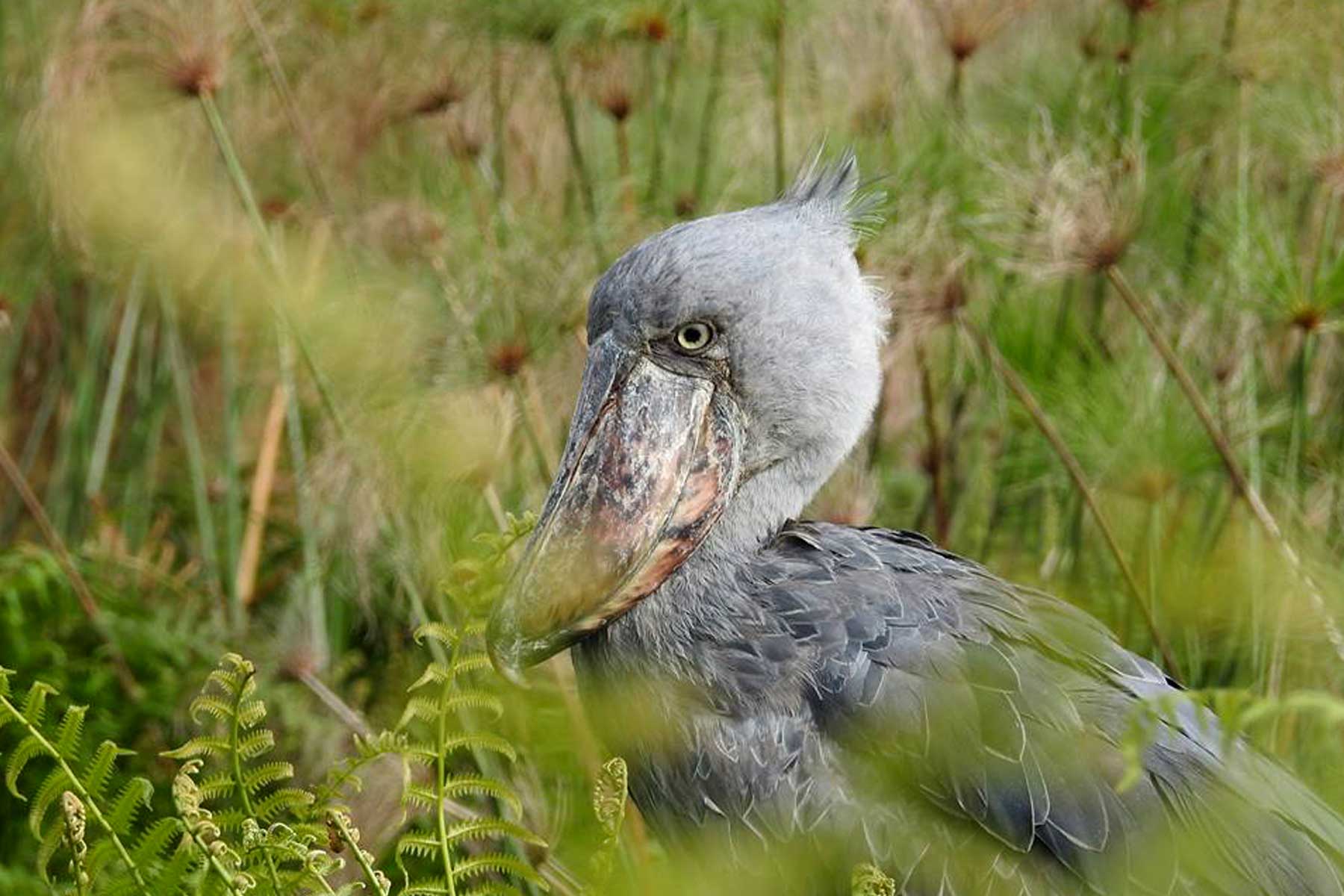
On our way to Murchison Falls National Park, we normally stop by the road side and search the swampy marshes on the right and side right after Luwero town. Every once in 9 times, we will see the elusive shoebill stork in its marshy dwellings. When seen, it is a sight to behold, as its prehistoric looks strike as much fear in us as they do in the frogs, baby crocodiles, lungfish and the rodents this giant of a bird eats. The shoebill, also known as the whale bird, can grow to four feet in height with a wingspan of seven feet. It has an oversized beak and exceedingly large eyes. The shoebill has a prehistoric dinosaur like look to match its scary nature. Shoebills have been known to live for up to 50 years.

The shoebill is often found in a still stance as it hunts with great patience. Shoebills can silently perch at the water’s edge for hours waiting for the right time to snap down on their favourite fish.However the shoebill can also be loud as it claps the mandibles of its bill together as a display, producing a loud, hollow sound. This is done during mating season to attract mates. Shoebills normally lay two eggs but only one hatchling will survive to fledge. The larger shoebill will normally fight and chase off the smaller hatchling from the nest. Shoebills can be seen across East and central Africa in Zambia, Tanzania, Sudan and Uganda. In Uganda, shoebills can be seen on the Nile delta in Murchison Falls national park, in the Mabamba swamp near Entebbe and in wetlands near Luweero. Shoebills are an endangered species and are listed on CITES.

What is the Cost of Gorilla Trekking 2025?

What is the cost of Gorilla Trekking 2025 in Uganda?

A Gorilla trekking  permit costs $800 USD per person per trek for foreign non-residents. For foreign residents it costs $700 USD, $500 USD  for the rest of African Citizens, and $85 USD for East African Citizens (Uganda/Kenya/Tanzania/Burundi/South Sudan). Uganda has half of the mountain gorillas population and 2 trekking parks namely Bwindi Impenetrable Forest and Mgahinga National Parks. Uganda’s parks have 17 gorilla families, 16 in Bwindi Impenetrable and 1 in Mgahinga National Parks hence only 136 gorilla permits are available per day in Uganda. The standard gorilla trekking permit will afford you an hour with the gorillas

For those that want to spend more time with the gorillas, we recommend the gorilla habituation experience where trekkers can spend up to four hours with a gorilla family in the presence and guidance of researchers and trackers.  A gorilla habituation permit costs $1500 per person per day. Only 4 permits are available per group per day. 

The demand for Gorilla trekking permits is always high because there are only 168 permits available per day across 4 tracking sectors in Bwindi. We therefore recommend that you book your permit at least 6 months in advance. 

The best time for booking your gorilla trekking safari is January – December (all year round). Gorilla permits can now only be booked through registered and licensed  tour operators like Buutu Safaris.

What is the cost of Gorilla Trekking 2025 in Rwanda?

A Gorilla trekking  permit costs $1,500 USD per person per trek for foreign non-residents, $500 USD for Foreign Residents, and $200 USD for East African Citizens (Uganda/Kenya/Tanzania/Burundi/South Sudan). In Rwanda, gorilla trekking is done in only Volcanoes National Park. There are 12 gorilla families so the total number of permits available per day is 96 gorilla permits. Unlike Uganda, there is no opportunity for gorilla habituation in Rwanda.

Gorilla permits can only be obtained through licensed/registered tour operators like Buutu Safaris.

When Is the best time to witness the Great Migration?

The year-round Great Migration along with the Big 5 are on the bucket list of must-see African wildlife spectacles.

Considered the most thrilling spectacle in the animal kingdom, the annual mass migration of wildebeest and other herbivores, with their ever-attendant entourage of predators is a breathtaking experience.

In this year-round cycle across the Serengeti-Mara ecosystem, over 1.5 million wildebeest, 400,000 zebra, 300,000 Grant’s and Thomson’s gazelle and 12,000 eland throng the landscape, following the rain, in search of fresh pastures.

The timing of this phenomenon has changed in recent years due to uncertain rainfall patterns, with herds splitting and moving in different directions, before reassembling again.

Rotation of the wildebeest movement:

Jan – Mar: The herds are usually calving and feeding on short grass in southern serengeti, Northern Ngorongoro( Nduutu area). This part of the country has nutrient rich soils that are good for the wildebeest and their calves.

Apr – May: This time of the year the herds move in splinter groups through the central to the Gurumeti river. This is usually the best time 

Jun – Jul: Depending on the amount of rain during this time. The herds are congregating in the western corridor before moving to the north.

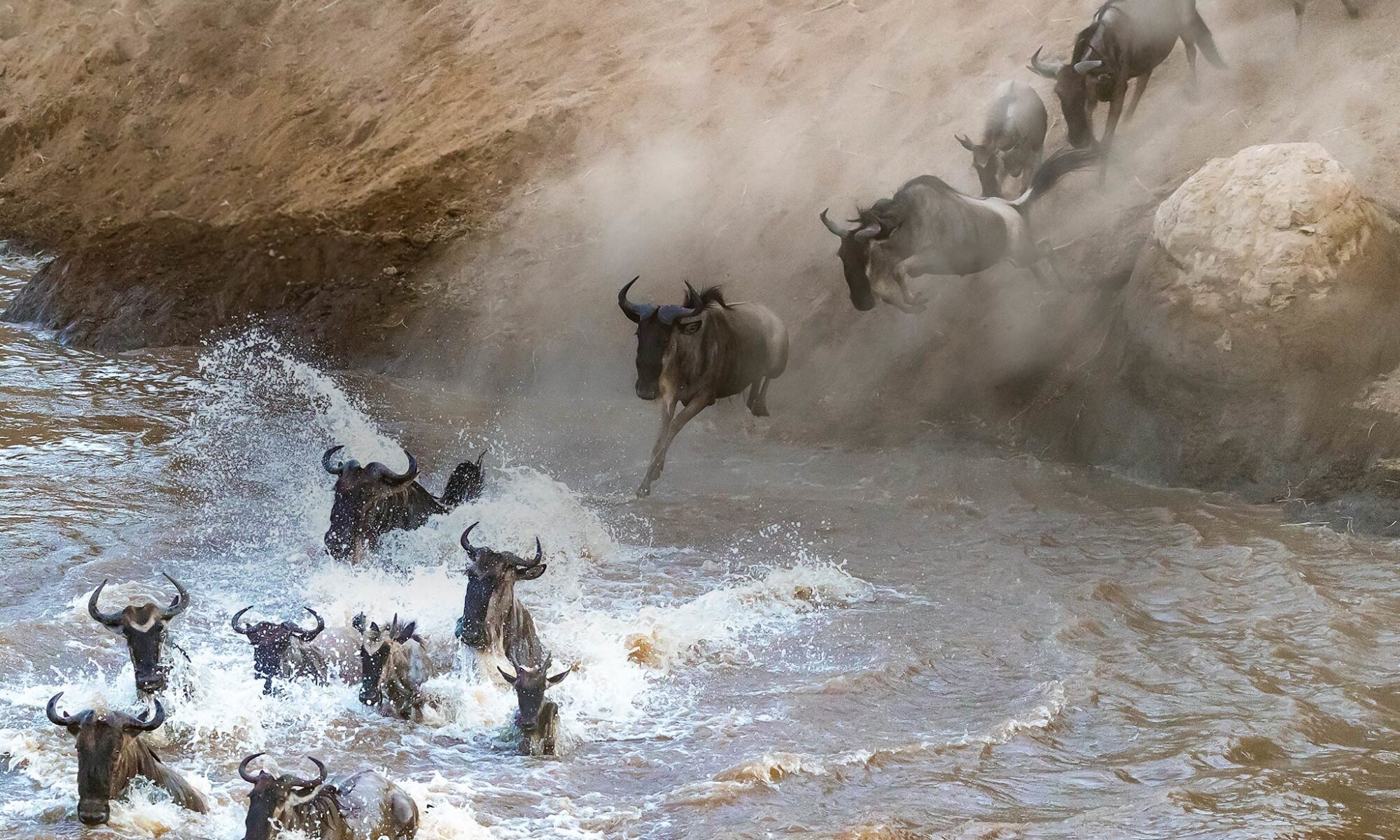
Aug: By August, the herds have faced the challenge of crossing the Mara River and are spread throughout the Masai Mara’s northern region, with many remaining in the northern Serengeti. In years when the river is in full flow, the panic and confusion at the crossings — combined with waiting predators and surging currents — can cause massive loss of life. But, even in years of relatively gently flowing water, the crocs take their toll, not to mention the lions and other large predators that patrol the banks, ready to ambush any wildebeest that make it to the other side. 

Sept –  Oct, the main chaos has ended and the migrating columns have gradually moved eastward. However, the wildebeest will face the heavy waters of the Mara River once more as they prepare to cross once again for their return journey southwards.

Nov: the rains begin propelling the wildebeests down south to the rejuvenating grasses in the serengeti.

Dec: The herds congregate on the short grass plains of the southern Serengeti and northernmost regions of the Ngorongoro Conservation Area. An estimated 500 000 calves are born during a two- to three-week window in February. This mass calving draws a staggering number of predators eager to prey on the vulnerable newborns.

Our conclusion:

Jun-August is the best time to witness the great migration. During this time the number of animals migrating across parks is at its highest, with predator numbers high as well to take advantage of the opportunity to snatch up prey making its way across to the river. 

A Guide Gorilla Trekking Adventure in Rushaga

mmerse yourself in the heart of Bwindi Impenetrable National Park and embark on an unforgettable gorilla trekking adventure in the Rushaga sector. This remote and enchanting region offers a unique opportunity to encounter these majestic creatures in their natural habitat.

Why Choose Rushaga for Gorilla Tracking?

The Rushaga sector is home to several habituated gorilla families, making it an excellent choice for gorilla trekking. Here’s why you should consider this destination:

  • High Success Rate: With multiple habituated families, the chances of finding and spending time with gorillas are high.
  • Remote and Peaceful: The Rushaga sector is less crowded than other areas of Bwindi, allowing for a more intimate and peaceful experience.
  • Stunning Scenery: Trek through lush rainforests, rolling hills, and breathtaking views.
  • Cultural Immersion: Experience the rich culture of the local Batwa people, the original inhabitants of the forest.

Planning Your Gorilla Tracking Adventure

Before you embark on your gorilla tracking adventure, here are some essential things to consider:

  • Permits: Gorilla trekking permits are limited and in high demand. Book your permit well in advance through a reputable tour operator or directly with the Uganda Wildlife Authority.
  • Physical Fitness: Gorilla tracking involves hiking through challenging terrain, so it’s important to be in good physical condition.
  • What to Pack: Pack comfortable hiking boots, rain gear, insect repellent, sunscreen, and a first-aid kit.
  • Respectful Behavior: Remember to maintain a safe distance from the gorillas and follow the guidelines set by your guide.

A Day of Gorilla Tracking

Your gorilla trekking adventure will begin early in the morning with a briefing at the park headquarters. You will be assigned a group and a guide who will lead you through the forest. The trek can take anywhere from 30 minutes to several hours, depending on the location of the gorilla family.

Once you find the gorillas, you will have one hour to observe them in their natural habitat. This is a truly magical experience that will stay with you forever.

Beyond Gorilla Tracking

In addition to gorilla tracking, there are many other activities you can enjoy in the Rushaga sector, including:

  • Hiking to the Batwa Cultural Trail
  • Visiting the Nkuringo Community Center
  • Birdwatching
  • Nature walks

Tips for a Successful Gorilla Tracking Experience

  • Book your trip during the dry season (June to September and December to February) for better weather conditions.
  • Hire a reputable tour operator with experienced guides.
  • Be prepared for challenging terrain and changing weather conditions.
  • Respect the gorillas and their habitat.
  • Relax and enjoy the experience!

Gorilla tracking in Rushaga is an unforgettable adventure that offers a unique opportunity to connect with these incredible creatures. With careful planning and a sense of adventure, you can make your dream of seeing gorillas in the wild a reality.

A Guide to Gorilla trekking in Buhoma

Buhoma, located in the Bwindi Impenetrable National Park in southwestern Uganda, is one of the most popular destinations for gorilla trekking in the world. Here, you have the chance to encounter these gentle giants in their natural habitat, an experience that is sure to be the highlight of your trip to Uganda.

Planning Your Trip

Before you embark on your gorilla trekking adventure, there are a few things you need to know.

  • Permits: Gorilla trekking permits are limited and can sell out quickly, so it is important to book your permit in advance. You can book your permit through a tour operator or directly through the Uganda Wildlife Authority (UWA).
  • Best Time to Visit: The best time to visit Buhoma for gorilla trekking is during the dry seasons, from June to September and from December to February. During these months, the weather is typically dry and sunny, making it easier to spot the gorillas.
  • What to Pack: Be sure to pack comfortable walking shoes, long pants, a long-sleeved shirt, a raincoat, and insect repellent. You will also need to bring a daypack with snacks, water, and binoculars.

The Gorilla Trek

Gorilla trekking is a challenging but rewarding experience. The trek can take anywhere from a few hours to a full day, depending on the location of the gorilla family you are tracking. Once you find the gorillas, you will be able to spend an hour with them before you have to leave.

Tips for a Successful Trek

  • Stay Quiet: Gorillas are shy creatures, so it is important to stay quiet during the trek.
  • Follow Your Guide’s Instructions: Your guide will know the best way to approach the gorillas and will keep you safe.
  • Respect the Gorillas’ Space: Do not get too close to the gorillas or make any sudden movements.
  • Bring a Camera: You will want to capture this once-in-a-lifetime experience on camera.

Other Things to Do in Buhoma

In addition to gorilla trekking, there are a number of other things to see and do in Buhoma. You can visit the Batwa Cultural Center, go on a nature walk, or visit the Buhoma Community Rest Camp.

Conclusion

Gorilla trekking in Buhoma is an unforgettable experience. If you are looking for an adventure that will take you off the beaten path, then this is the perfect destination for you.